You have a toolbox, yet you’re wondering which label is best to use; magnetic or adhesive labels? In this article, we’ll walk you through both options as if it were a real shop decision, with concrete examples, trade-offs, and guidance on which to choose depending on how you actually use your toolbox.
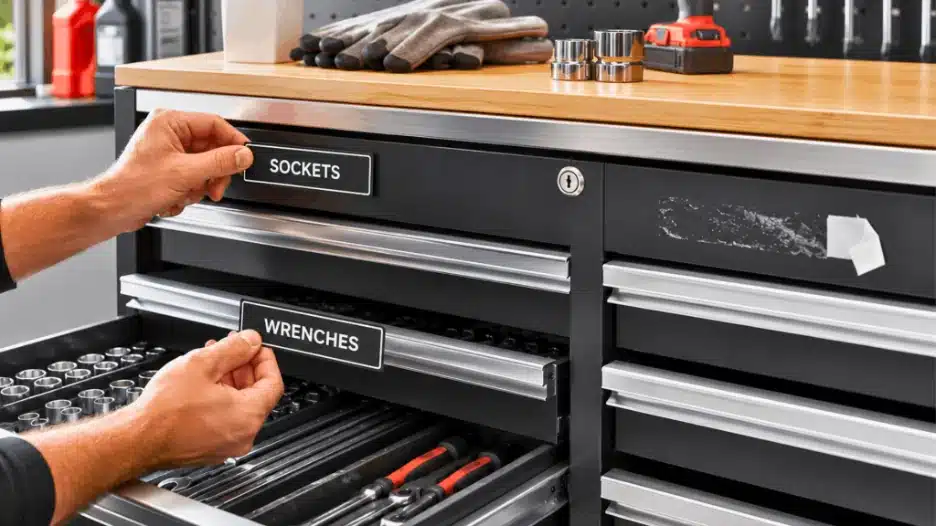
If you expect your layout to change, Magnetic labels are usually the best choice for metal toolbox drawers, because they are removable and repositionable without residue. Adhesive labels are usually better for non-magnetic surfaces or truly permanent setups, but they can create cleanup work later if you ever need to update your system.
To see the full article that walks you through how to organize your toolbox step by step, check out this guide.
| Spec | Magnetic Labels | Adhesive Labels |
| Best surfaces | Metal toolboxes, metal cabinets, steel shelving | Metal, plastic, wood, painted surfaces (depends on adhesive) |
| Best use case | Reorganizing drawers, shared toolboxes, “labels that move with your system” | Permanent labeling, long-term storage bins, non-magnetic surfaces |
| Easy to change later | Very easy, move and reuse | Usually a hassle, peel off, clean residue, reapply |
| Risk in real shops | Can shift if magnets are weak or drawer face is uneven | Edges can lift, adhesive can fail, can leave residue |
| Cleanliness | Typically stays clean because there’s no glue | Can attract grime at lifted edges, can leave sticky residue |
| Upfront cost | Often higher | Often lower |
| Long-term value | High if you update your layout | High only if your system stays the same |
| Common buyer keyword match | “Magnetic toolbox drawer labels”, “removable drawer labels”, “toolbox labels” | “Adhesive labels”, “permanent labels”, “storage bin labels” |
What are magnetic labels?
Magnetic labels stick directly to a metal surface, held by a magnetic backing, with no glue involved. This tends to matter most when you have a toolbox with steel shelving.
Of course, tools are used every day and can sometimes get mixed up or messy. Sometimes your “wrench drawer” becomes the “wrench plus specialty sockets” drawer. Your “electrical” drawer slowly turns into “electrical and random fasteners.”
When this happens, it gets way easier to reset with the magnetic label, because your label can move with your system, and the whole toolbox stays easier to use.
In addition, if you’ve ever peeled off an old adhesive label and spent five minutes rubbing off the sticky film, you already understand why magnetic drawer labels are appealing.
What are adhesive labels?
Adhesive labels are the classic stick-on option. The moment you apply them, ideally, they stay put. They can be paper, vinyl, laminated, and a bunch of other materials, but the feature that matters is the adhesive.
If you’re labeling plastic bins, wood shelves, or anything non-magnetic, adhesive labels are often the obvious solution. They can also be great when you want permanence, and you are confident the label will not change for a long time.
The catch is that your easy setup choice can become the annoying one later on as your tools evolve. That is where most frustration comes from.
Differences between Magnetic and Adhesive Labels
The biggest difference is not durability, even though that is what people think they are comparing. The biggest difference is what happens when your labels become wrong.
With magnetic labels, the fix is simple. You move the label. That’s it.
With adhesive labels, the fix usually becomes messy. Now you have to start peeling it off, scrape or wipe the residue, which can possibly damage the finish if it’s a stubborn adhesive, then apply a new label and hope it aligns with the others. If you are doing that across 10 drawers, you feel it.
There’s also a surface difference that matters. Magnetic labels are basically “metal-only” unless you add a metal plate. Adhesive labels can go on almost anything if you prep the surface well.
Finally, there’s the shop grime factor. Adhesive labels often fail at the edges first, and once an edge lifts, it collects dust and oil and turns gross. Magnetic labels skip that whole edge-lifting-from-adhesive problem, but they can slide if the magnet strength is weak or the drawer face is uneven.
Similarities between Magnetic and Adhesive labels
Both magnetic and adhesive labels solve the same core problem. They make tools faster to find, reduce junk drawers, and they make it easier to put things back where they belong. If you have ever watched someone else borrow a tool and then guess where it goes, you already know why labeling matters.
Both options can look clean and professional when done well. Both can be customized in text, color, and layout depending on what you buy. Both can also look sloppy if the label design is hard to read, too small, or inconsistent across drawers.
So yes, both work. The better choice is the one that fits your surface and how often you change your setup.
Pros and cons for Magnetic Labels
Pros
- Easy to reorganize without extra work. If you change drawer categories a lot, you can move the labels around in seconds instead of peeling and redoing everything.
- No adhesive residue to deal with. You are not scraping glue off drawer fronts or fighting sticky build-up later.
- Great for shared or evolving toolboxes. If multiple people use the same chest, or your tool set grows over time, the labels can evolve with it rather than become “wrong.”
- Cleaner, more professional look long-term. Since there are no peeling edges from glue, the setup usually stays looking tidy longer.
Cons
- Needs a magnetic surface. They are ideal for steel drawers and metal cabinets, but not for plastic bins or wood shelves unless you add a metal plate.
- Can shift if the magnet strength is weak. If the magnets are not strong enough or the drawer face is uneven, labels can slide slightly over time.
- Quality matters more than people expect. A good magnetic label feels solid and stays put. A cheap one can become annoying fast if it moves every time you open and close drawers.
Pros and cons of adhesive labels
Pros
- Works on almost any surface. Plastic bins, wood shelves, painted cabinets, wall organizers, and more. This is the biggest reason people choose adhesive labels.
- Lower upfront cost in most cases. If you are labeling a lot of storage quickly, stick-on labels are usually the cheapest way to do it.
- Solid choice for permanent systems. If your categories will not change for a long time, adhesive labels can be simple and dependable.
- Can be very thin. Helpful in tight-clearance spots where a thicker label might rub or catch.
Cons
- Reorganizing can turn into a cleanup job. If you change categories later, you may need to peel labels off, remove residue, and reapply new ones.
- Possible residue or surface damage on removal. Some adhesives leave sticky film, and some can pull at paint or finishes depending on the surface and how long they’ve been on.
- Edges can lift in real workshop conditions. Dust, oil, cleaners, humidity, and friction near drawer fronts can cause corners to peel, and once that starts, the label looks worn fast.
Quick tips: if you can confidently say, “This label will still be correct a year from now,” adhesive labels are a reasonable pick. If you cannot, removable options usually feel better to live with.
Conclusion
If you are labeling a metal toolbox or tool chest, magnetic labels are usually the better real-world choice, especially if you want a system you can keep up to date. The fact that it doesn’t leave residue on the surface of the toolbox and that you can also move it anytime makes it a good fit for a metal toolbox. The “no residue, move it anytime”
If you are labeling plastic bins, wood shelves, or non-magnetic storage, adhesive labels are usually the practical winner because they work everywhere. They are also a good choice for truly permanent labeling, where you know the category will not change.