If you want to protect several toolbox drawers on a budget, we’d choose a universal drawer liner. You can cut one roll to fit drawers of different sizes. It’s also a good choice if your sockets and wrenches already have their own trays.
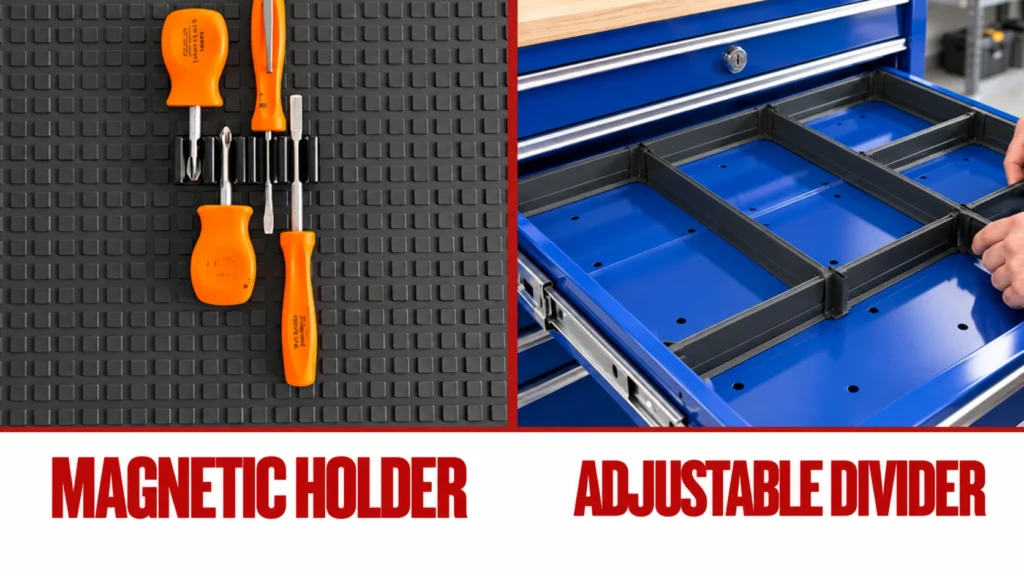
If your screwdrivers roll together every time you close the drawer, we’d choose a modular toolbox mat with compatible holders. We make ours for select Snap-on drawers. The mat gives you a fitted base, and the holders give each screwdriver its own spot.
Key Differences Between Modular Mats and Universal Drawer Liners
Both options can protect the bottom of your toolbox drawer, but they are designed for slightly different needs.
| Feature | Modular Toolbox Mat | Universal Drawer Liner |
| Fit | Designed around compatible drawer dimensions | Cut to fit the drawer |
| Installation | Pieces are arranged and fitted together | Usually placed in the drawer after cutting |
| Tool organization | Some systems accept compatible tool attachments | Usually provides a flat protective surface |
| What keeps tools in place? | On our mat, compatible holders keep screwdrivers in their spots. Loose tools can still slide. | A textured liner can help tools grip the surface. Round tools can still roll |
| Cost | Can have a higher initial cost | Usually more affordable |
What Is a Modular Toolbox Mat?
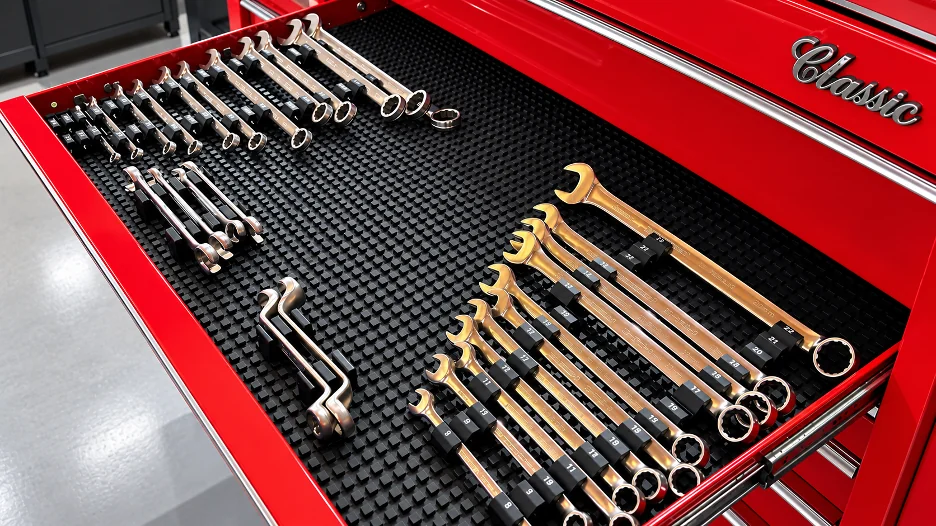
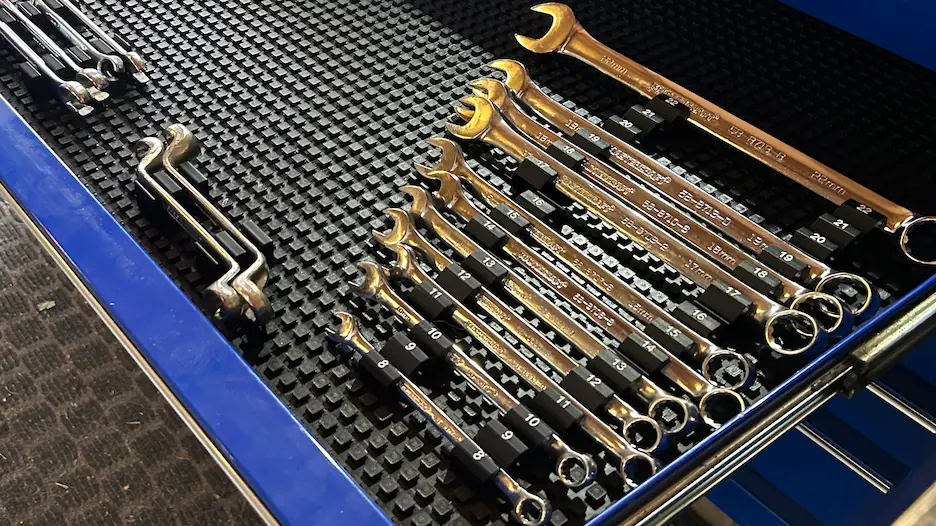
A modular toolbox mat covers the bottom of a drawer with pieces that fit together. We 3D-print ours from PETG plastic and size the pieces for select Snap-on Classic drawers.
The mat itself is nonmagnetic. If you lay a screwdriver on the bare mat, it can still roll. A compatible screwdriver holder attaches to the mat and uses magnets to hold the screwdriver in place. You can arrange the holders to suit the tools you own.
Before choosing a size, measure the inside width and depth of your drawer and compare them with our modular tool mat dimensions.
Benefits of a Modular Toolbox Mat
1. It provides a more fitted surface
One of the main benefits of a modular mat is that its pieces can be arranged to fit compatible drawers. When the measurements are correct, the mat can cover the drawer more neatly than a liner that has been cut by hand.
A good fit also helps reduce the chance of loose edges getting in the way when you move tools around.
2. It helps keep tools organized
Modular systems allow you to add attachments for particular tools. This can be useful for mechanics who want their sockets, screwdrivers, and other tools to have their own places.
Instead of having everything lying flat in a drawer, you can arrange tools in a way that makes them easier to find. If you are considering a setup for specific tools, you can also explore these tool organizer options.
3. It can help reduce tool movement
A properly fitted mat can help keep the drawer surface organized and reduce movement caused by a loose or poorly fitted liner. When combined with suitable tool attachments, it can also help hold selected tools in place.
This is useful if you open and close your toolbox many times during the day.
4. It gives the drawer a neat appearance
Modular mats can give a toolbox a more organized look because the pieces fit together in a planned layout. This can be especially useful in a professional workshop where you want to keep tools arranged consistently.
Limitations of a Modular Toolbox Mat
1. The initial cost can be higher
A modular system may cost more than a basic universal liner. If you want to cover several drawers or add tool attachments, the total cost can increase.
For someone who only needs a simple protective layer, that extra cost may not be necessary.
2. You need to measure the drawer carefully
Not every modular mat fits every toolbox. Some are designed for specific models and drawer dimensions, so you should not assume that a mat will fit just because it looks close to the right size.
Measure the inside of your drawer and compare it with the recommended mat dimensions before making a decision.
3. Some attachments may cost extra
Depending on the system, tool-holding attachments may be sold separately. This means you should check what is included with the mat and what you would need to purchase separately.
What Is a Universal Toolbox Drawer Liner?
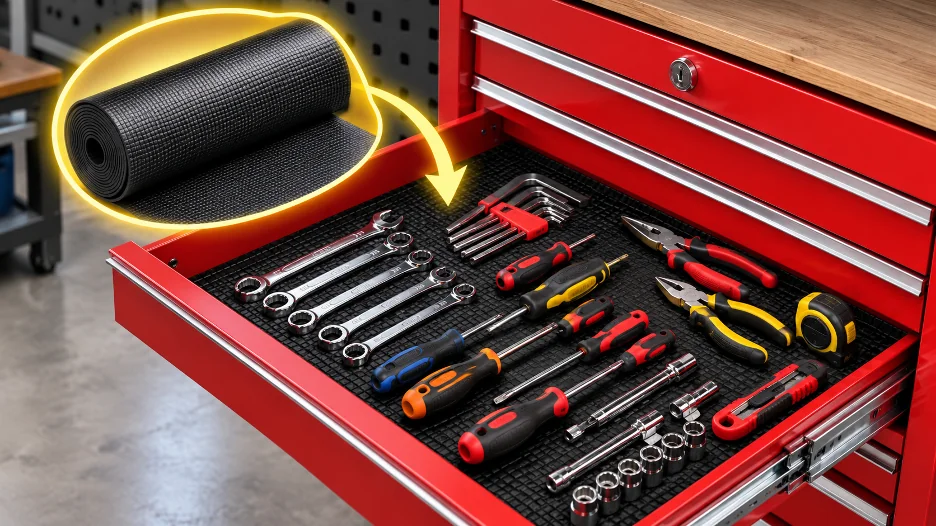
A universal toolbox drawer liner is a sheet of material that you place at the bottom of a toolbox drawer. It is usually supplied in a roll or sheet and can be cut to fit the space.
Universal liners come in different materials, thicknesses, and surface textures. Some have a smooth surface, while others have a textured or cushioned finish to help reduce tool movement.
They are a common choice for home garages, DIY car owners, and people who want to protect their toolbox without spending too much.
Benefits of a Universal Toolbox Drawer Liner
1. It is usually more affordable
Universal liners are often cheaper than modular mats. If you have several drawers to cover, buying a roll or sheet and cutting it to size can be a budget-friendly option.
This makes them suitable for people who want basic drawer protection without needing a more structured organizer system.
2. It is easy to cut to size
You can trim a universal liner to match the shape of your drawer. This makes it flexible for different toolbox sizes and layouts.
You do not always need a liner made for a specific toolbox model. However, you still need to measure carefully so the material covers the drawer properly.
3. It is available in different materials and textures
Universal liners come in several types. Some are thin and smooth, while others have a thicker or more textured surface.
The right option depends on the tools you store and the kind of protection you need. A textured liner may help reduce sliding, while a softer material can provide some cushioning.
4. It is simple to replace
If a universal liner becomes worn, dirty, or damaged, you can usually remove it and cut a new piece. You do not need to replace a complete modular system just to refresh the drawer surface.
Limitations of a Universal Toolbox Drawer Liner
1. A poor fit can cause problems
We cut one drawer liner slightly too short. That left a strip of the drawer exposed, and dirt collected under the loose edge. When cutting a replacement, we’d leave a little extra on the first cut, lay it in the drawer, and trim it until it sits flat.
2. It may not hold every tool in place
A drawer liner can help reduce movement, but it does not automatically keep every tool in a fixed position. Heavy sockets, loose wrenches, and other tools can still move when the drawer is opened or closed.
If you want each tool to stay in a particular spot, you may need separate organizers or holders.
3. The material can wear over time
The durability of a universal liner depends on its material, thickness, and how you use it. Some liners may flatten, tear, curl at the edges, or become difficult to keep clean after regular use.
Choosing a suitable material can help, but a basic liner is not necessarily designed to handle every workshop condition.
Which Option Is Better for Preventing Tools from Sliding?
First, check what moves when you close the drawer. Does the liner bunch up at the back, or does it stay flat while the tools slide across it? Those are two different problems.
If the liner shifts, empty the drawer and check the fit. The liner should lie flat from front to back, with no edges folded up the sides. If the liner stays put but a flat wrench slides, a grippier liner may be all you need.
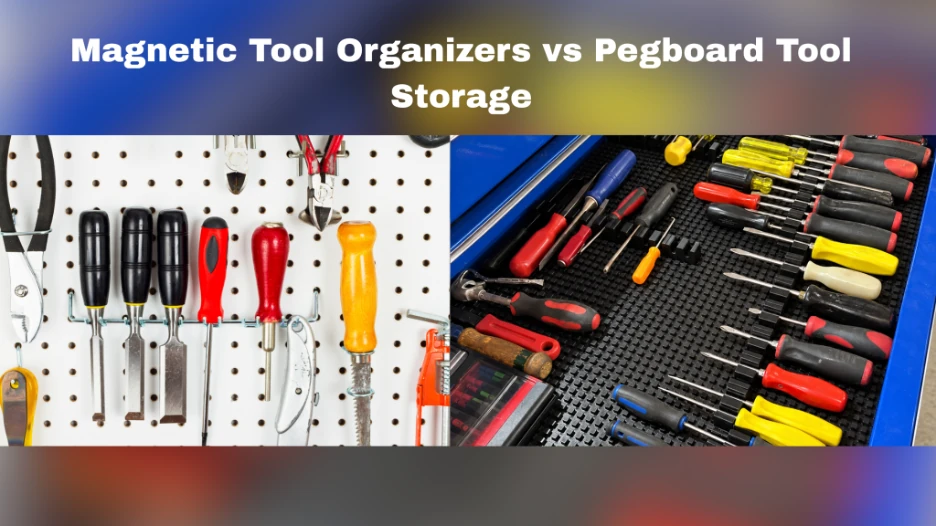
Round screwdriver handles can still roll on a textured surface. If you want to open the drawer and reach for the same driver in the same spot, we’d use a compatible holder on the modular mat.
Material and Thickness
The material and thickness of a toolbox mat or liner affect how it feels, how it fits, and how well it handles regular use.
A thin liner may be easy to cut and fit into a drawer, but it may offer less cushioning. A thicker liner can provide more padding, although it is important to check that it does not take up too much space or interfere with the drawer closing properly.
Modular mats may use more rigid materials to maintain their shape. For example, some modular systems use PETG plastic, which allows the pieces to form a structured surface.
Neither option is automatically better just because it is thicker or more rigid. Consider the tools you store, the drawer dimensions, and how much protection you need.
Resistance to Oil and Chemicals
Toolbox drawers in a working garage can come into contact with oil, grease, and other workshop substances. This makes material choice important.
Not every liner or mat has the same level of resistance. A material that handles ordinary dirt and light spills may not be suitable for prolonged contact with certain oils, cleaners, or chemicals.
Before buying, check the manufacturer’s information about the material and its resistance to the substances you use. Avoid assuming that a mat is chemical-resistant simply because it is made from plastic or rubber.
It is also a good idea to clean spills promptly. This helps keep the drawer in better condition and makes it easier to spot any wear or damage.
Cleaning and Maintenance
Both modular mats and universal liners need occasional cleaning, especially if you use your toolbox regularly.
A universal liner can usually be lifted out so you can clean the drawer underneath. However, if the liner has curled edges or does not fit properly, dirt can collect beneath it.
Modular mats can also be removed for cleaning, depending on their design. If your system has separate pieces or attachments, you may need to remove some of them to clean around the edges.
For either option, remove loose dirt first and use a cleaning method suitable for the material. Let the surface dry before putting it back in the drawer, particularly if moisture could become trapped underneath.
If you are looking at the bigger picture of keeping your tools in order, this step-by-step guide to organizing your toolbox covers other practical ways to maintain a tidy drawer setup.
How to Measure Your Toolbox Drawer Before Buying
Measuring your drawer is important, especially if you are buying a modular mat designed for specific toolbox dimensions.
Here is a simple way to do it:
1. Measure the inside width
Measure from one inside wall of the drawer to the other. Do not rely only on the outside width of the toolbox.
2. Measure the inside depth
Measure from the front to the back of the drawer. Make sure you are measuring the usable space where the mat will sit.
3. Check the drawer shape
Some drawers have corners, raised edges, or other features that may affect how a mat fits. Take these into account before choosing a size.
4. Compare your measurements with the product dimensions
Check the dimensions of the mat or liner before buying. For modular systems, even a small difference may affect the fit, so follow the product’s measurement guidance carefully.
5. Check the drawer clearance
Make sure the mat will not prevent the drawer from closing properly or interfere with any existing organizers.
If you are buying a universal liner, leave enough material to cover the bottom without forcing it up the sides. If it is designed to be cut, trim it carefully and check the fit before putting your tools back.
Can You Use Both in the Same Toolbox?
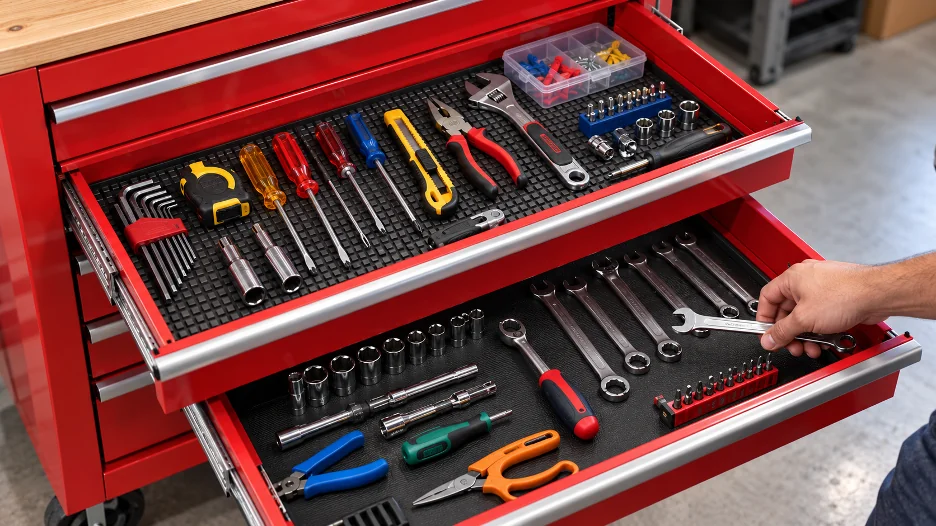
Yes. We’d choose drawer by drawer. If your sockets already sit on rails and your wrenches sit in a tray, a cut-to-fit liner can protect the drawer underneath. Those tools already have a place, so there’s little reason to pay for another organizing system in that drawer.
The screwdriver drawer is where we’d spend the extra money. If the handles roll together and you have to lift two drivers to see the one underneath, a fitted mat with individual holders solves a problem you notice every time you reach for a tool. Before buying, check the drawer dimensions and make sure your tallest handle will clear the drawer above it.
Frequently Asked Questions
Conclusion
For most drawers, we’d start with a universal liner. It’s the more affordable choice when you want to cover the drawer bottom or add grip beneath tools that already have organizers.
We’d choose the modular mat for a compatible screwdriver drawer where each tool needs its own spot. Compare the cost of the mat and the holders you’ll need with the cost of lining that drawer. That gives you a fair comparison before you buy.