Toolbox labels help you identify drawer contents and put tools back where they belong. The right choice depends on your drawer surfaces, workshop conditions, budget and how often you reorganize.
This guide compares five options: printed magnetic labels, adhesive stickers, label maker tape, engraved plates and handwritten tape. Each has advantages and limitations, from quick DIY installation to custom wording and reusable attachment.
Magnetic labels are useful for drawer fronts that attract magnets, especially when you want to move labels as your layout changes. Adhesive labels can suit non-magnetic surfaces, while engraved plates are worth considering for a more permanent setup.
| Label Type | Main Benefit | Key Limitation |
|---|---|---|
| Magnetic Labels | Reusable and easy to reposition | Need a surface that attracts magnets |
| Adhesive Labels | Work on suitable non-magnetic surfaces | May leave residue when removed |
| Label Maker Tape | Print custom names on demand | Size and durability depend on the tape |
| Engraved Plates | Engraved text for fixed layouts | Moving them depends on the mounting method |
| Handwritten Tape | Quick and inexpensive to make | Can fade, peel or become hard to read |
Printed Magnetic Tool Labeling
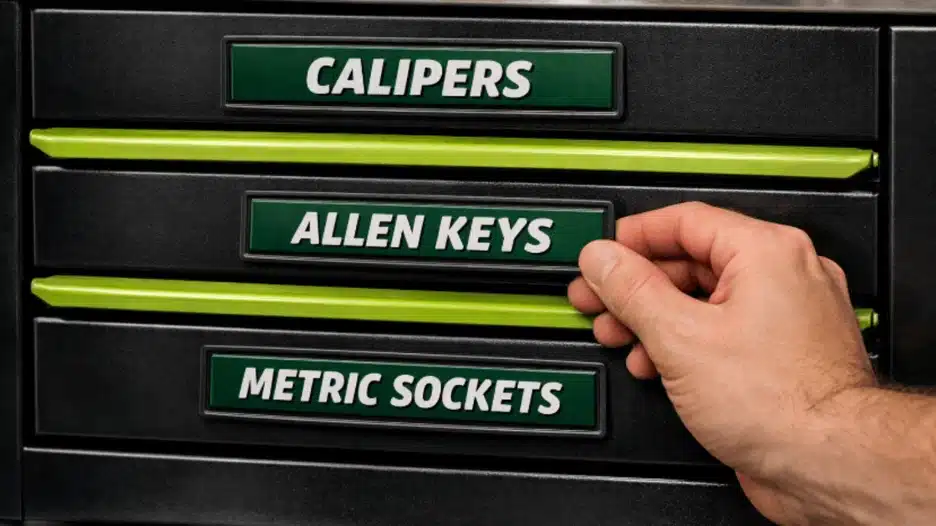
Printed magnetic labels are small rectangular labels with a magnetic backing, with your chosen text printed directly on the face.
Magnetic toolbox labels attach without adhesive and can be repositioned whenever you reorganize your drawers. They work on steel and other surfaces that attract magnets. Before ordering, test your drawer fronts with a magnet—aluminium, plastic and some stainless steel surfaces won’t hold magnetic labels.
What makes the printed version different from a blank magnetic label is the customization. You are not writing on it yourself or printing at home.
You submit your exact drawer text, choose a font, and choose a color combination, and what arrives is a professionally finished label made specifically for your setup.
The Custom Magnetic Toolbox Labels from Automotive Accessories NA come as a set of 8, with full customization on each label. Font options are Anton, Roboto, and EXO-2, all clean and bold enough to read quickly from a standing position.
Color combinations include black on white, white on black, white on green, white on blue, and more.
Each label measures 12.5 x 2.54 x 0.8 cm, is made from PLA, is manufactured in Canada, and ships free to Canada, the USA, and Australia for $39.99 CAD.
The main advantage of magnetic toolbox labels is that you can reposition them without replacing adhesive. When you move tools between drawers, lift the corresponding label away and place it on another compatible drawer front.
How securely a label holds depends on the magnets, the mounting surface and contact between them. Keep the drawer front and magnet contact surfaces clean, and lift labels when moving them to reduce the chance of dragging trapped grit across the finish.
The honest weaknesses are worth knowing too. The upfront cost is higher than tape or stickers: $39.99 CAD for a set of 8, compared to a few dollars for adhesive alternatives.
They also require a metal drawer face that attracts magnets, so if your storage unit has plastic drawers, magnetic labels won’t hold. And because they’re custom-ordered, you don’t have them in ten minutes the way you do with a label maker.
The product also comes with three guarantees that are worth calling out. An Arrives Safe Guarantee means that if anything is damaged in transit, it is replaced at no cost.
A Precision Print Guarantee covers any defective print. And there’s a 14-day hassle-free return policy that covers return postage.
Adhesive Sticker Labels
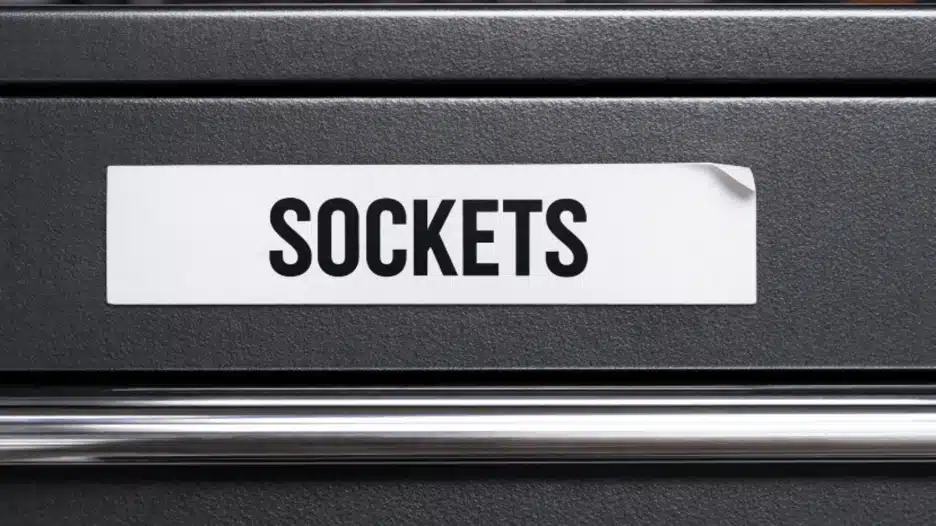
Adhesive sticker labels are the first thing most people reach for. Printable toolbox labels that you design at home and print on a standard label sheet are probably the most common version of this.
You peel the backing and stick them straight onto the drawer face. The appeal is obvious; they’re cheap, available immediately, and take about thirty seconds to apply.
The problem is what happens in month three. Garage temperatures cycle between seasons, and that thermal expansion and contraction gradually weakens adhesive bonds on metal surfaces.
Grease from your hands gets under the label edges every time you open a drawer, and once it starts lifting in one corner, the whole thing follows.
Pull it off, and you’re left with a sticky residue patch on the drawer face that is genuinely annoying to clean off powder-coated or painted metal.
They work fine for a bookshelf in an office or a pantry shelf in a kitchen. In a working garage, they are a short-term solution that creates a longer-term cleaning problem. And when you want to reorganize, moving an adhesive label means destroying it and starting over.
Label Maker Tape
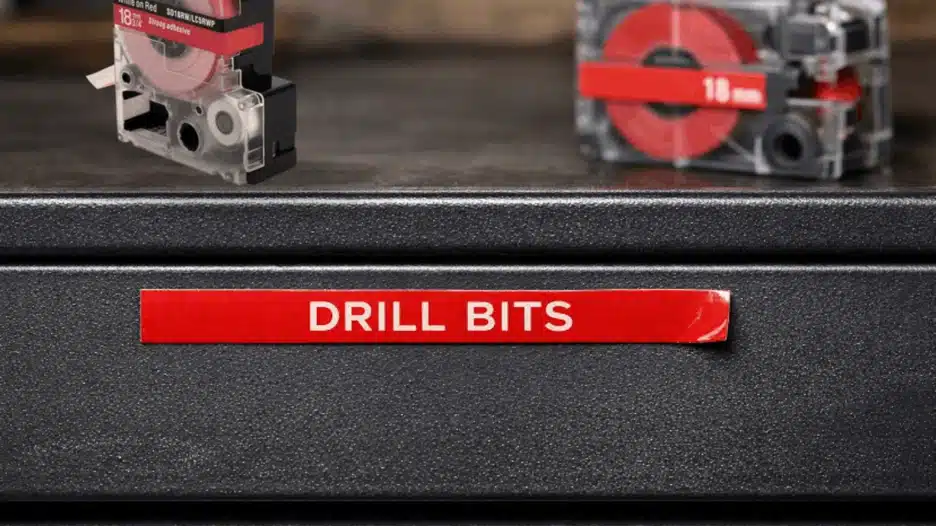
A label maker for toolbox organization is something many mechanics buy early on because it feels like a proper system.
It prints text onto a narrow strip of laminated adhesive-backed tape; the lamination adds a basic layer of moisture resistance, and for quick organization tasks in a house or office, it does the job without much fuss.
For a toolbox, the format works against you in two ways. First, the tape is narrow, which forces either a small font or a very short label.
Either way, reading a small, narrow label quickly from a standing position in imperfect workshop lighting is harder than it sounds.
Second, the adhesive backing fails in the same garage conditions that kill sticker labels.
The lamination layer doesn’t protect the adhesive underneath from grease and heat. You’re buying a slightly more durable version of the same fundamental problem.
Most mechanics who start with a label maker outgrow it within a year. It’s a fine temporary tool, but not a system.
Laser Engraved Plates
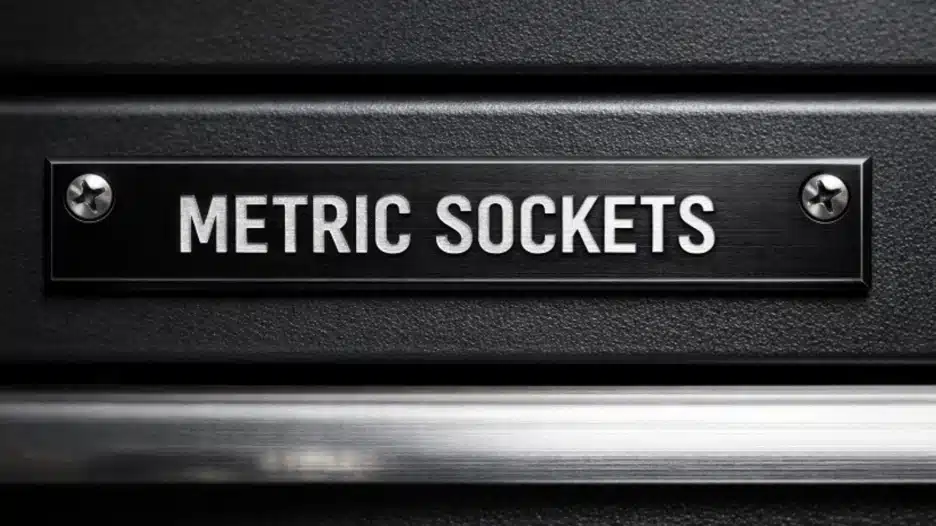
Laser-engraved plates are metal or acrylic plates with text permanently etched into the surface. In terms of durability, they are unbeatable.
The text never fades, never peels, and never degrades, regardless of how long they sit in a garage. The finished result looks sharp and genuinely professional, and if pure permanence is the only thing that matters to you, nothing beats laser engraving.
The problems show up when you look at the full picture. Cost is the first one.
Individual laser-engraved plates typically run USD 5 to USD 15 each, depending on material and size, so a full set for 8 drawers can cost USD 40 to USD 120 before any installation hardware. Installation is the second issue.
These plates need to be mounted to the drawer face with screws or strong adhesive, which means drilling into your toolbox or bonding something permanently to it.
For a rolling tool chest that gets moved around a shop, that’s not a practical approach for most people.
The third issue is the one that actually kills the value proposition for most mechanics, which is flexibility. A laser-engraved plate is permanent by design.
Every time you reorganize a drawer, add a new tool category, or change your setup, you’re left with either a mismatched label or mounting damage to deal with.
For a shop with a completely fixed setup that genuinely never changes, it’s valid. For anyone whose tool collection is still growing or whose work evolves, it’s an unnecessarily rigid and expensive solution.
Handwritten Tape
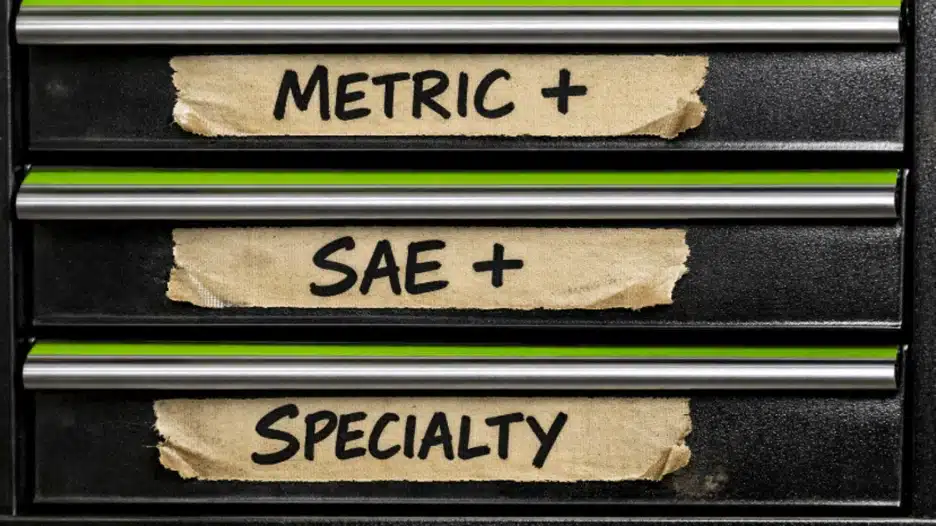
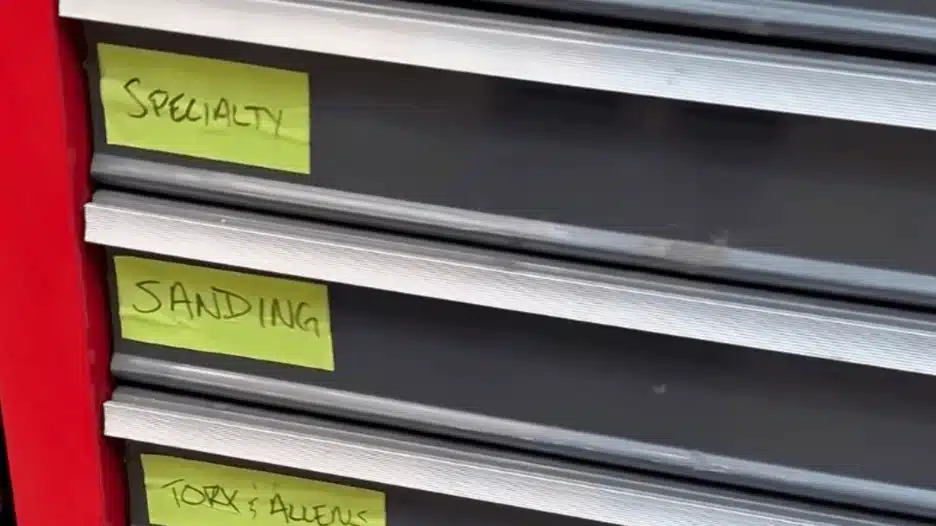
Masking tape and a marker. Most mechanics have done this as a temporary fix at some point, and there is genuinely nothing wrong with it in that context.
It costs almost nothing, takes 30 seconds, and at least conveys the basic idea of what’s in the drawer until a proper system is set up.
The issue is when temporary becomes permanent by default. The tape discolors within weeks in a garage environment.
The marker fades, especially in warm or sunlit spaces. The edges peel, and once they start peeling, they go fast.
In a professional shop, it sends the wrong signal about how seriously you take your setup. In a home garage, it just gets ignored until it falls off completely.
Handwritten tape is a placeholder. Use it that way, and it serves its purpose. Treat it as a long-term solution, and it will let you down every single time.
How All Five Labeling Tools Compare Side by Side
When you put all five options against each other on the criteria that actually matter in a garage, the picture becomes very clear.
In terms of durability, printed magnetic labels and laser-engraved plates both hold up over the long term. The other three deteriorate in a real shop environment within months. If durability alone decided the winner, it would be a tie between those two.
On repositionability, printed magnetic labels win completely. Laser-engraved plates are permanent. Adhesive stickers and tape can technically be moved, but not without damage and residue.
Handwritten tape can be replaced but not moved. For any setup that might change, and most setups do change as tool collections grow, only magnetic labels give you the freedom to reorganize without consequences.
On cost, handwritten tape and adhesive stickers are the cheapest upfront. Label maker tape is slightly more. Printed magnetic labels sit in the middle at $39.99 CAD for a set of 8.
Laser-engraved plates are the most expensive by a significant margin. But when you factor in replacement cycles, adhesive labels and tape need replacing every few months in a real garage, while magnetic labels last a long time. The long-term cost picture flips.
In terms of professional appearance, laser-engraved plates and printed magnetic labels both look genuinely intentional and sharp. The other three communicate varying degrees of temporary fixes regardless of how neatly they’re applied.
On practical installation, printed magnetic labels require no tools, no adhesive prep, and no hardware. Every other option requires at least some surface prep or a hardware commitment.
Which Toolbox Labels Should You Choose?
The best label depends on your drawer surfaces, budget and how often you reorganize.
For steel drawer fronts that attract magnets, printed magnetic labels offer a convenient way to identify your tools and move the labels whenever your layout changes. Custom wording also lets you name each drawer to match the tools inside.
Want labels made with your own drawer names?
Our set of eight custom magnetic toolbox labels costs $39.99 CAD and lets you choose the wording for each drawer, plus your font and colours. Check that your drawer fronts attract a magnet, then review the dimensions and customization options before ordering. A 25% tariff fee applies to U.S. orders at checkout.
Other options may suit your setup:
- Adhesive labels: Useful for non-magnetic surfaces. Choose a product rated for the surface and conditions where you’ll use it.
- Label maker tape: Convenient when you want to create or replace drawer names yourself.
- Engraved plates: Worth considering for a fixed layout where repositioning is less important. Check the mounting method before buying.
- Handwritten tape: An inexpensive way to test drawer names and layouts before committing to finished labels.
Already decided on magnetic labels and want the full step-by-step process for applying them properly? This guide covers everything: How to Label Toolbox Drawers the Right Way.
For more ways to use magnetic labels in your drawer organization system, read Printed Magnetic Labels to Fix a Messy Toolbox.