Sometimes your car just refuses to start, and you begin to wonder what is wrong. You check the battery and the engine, but nothing seems obviously wrong. What many people do not understand is that before your engine even agrees to start, there is a small electronic process that must be passed. And that process depends on a tiny chip inside your key that most drivers do not even know about.
What Exactly Is a Car Transponder?
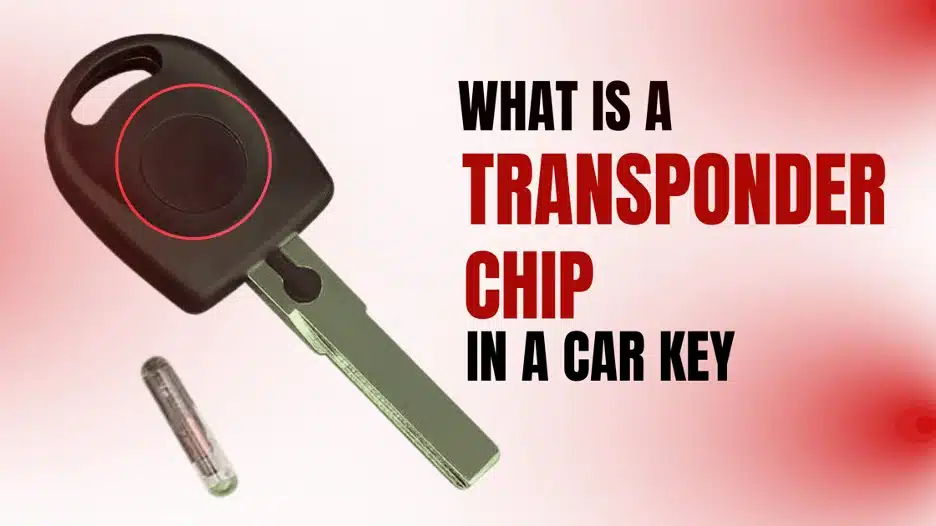
A car transponder is not some big complicated machine. It is actually a very small electronic chip device inside your car key.
When you insert your key into the ignition, the chip performs an important function. It transmits a coded radio signal to the car’s control unit. The car then checks that signal. If the code matches what the system expects, then the engine is allowed to start. Suppose it does not match the vehicle’s expectations. The car restricts the ignition immediately.
So if the car can’t identify your car key, it won’t start, even when you insert and turn the key in the ignition.
That means even if someone physically duplicates your key without the correct electronic code inside the transponder, the vehicle will refuse to start. The car is basically saying, “I don’t recognize you.”
This is why the transponder is part of the immobilizer system.
Why Was the Transponder Introduced?
Before this technology was introduced, stealing cars was way easier. If someone forced the ignition system or duplicated a car key, the vehicle could start without any additional verification. Thereby allowing a successful theft operation. There was no electronic layer to verify that the person starting the car was actually the owner.
As vehicle theft increased, manufacturers realized that mechanical security alone was insufficient.
They needed something that provides greater security yet is easy to use. It included an electronic verification mechanism, which ensured that even if someone gained physical entry to the vehicle, the engine would not start without the proper coded signal.
The idea was to combine physical accessibility with digital authentication. That way, starting the engine would require more than just turning a key.
From the late 1990s into the early 2000s, this technology became standard in most modern vehicles because it reduced unauthorized access to cars.
How Can You Tell If Your Key Has a Transponder?
Most people do not even know whether their key has a transponder. To know your car key type, there are simple indicators you can look out for.
Some of the common signs include:
A thick plastic cover on the key
- If the upper part of the key is bulky and covered with a plastic case, a chip may be embedded inside, unlike older car keys, which are usually plain metal.
The year of the vehicle
- Most vehicles manufactured since the late 1990s and early 2000s come with a transponder system as a standard security feature. If you drive a modern car, you’re likely to have one.
An immobilizer warning light on the dashboard
- If you see a small, security- or key-shaped light flashing when you insert the key, it indicates the vehicle is checking for electronic signals before starting.
The car refuses to start when a duplicated key is used
- If someone cuts a duplicate key and the engine still refuses to start, that is clear evidence that electronic recognition is required.
How to fix the transponder if it fails
Now, once the transponder develops a problem, the solution is not just guesswork. The car refused to start for a reason, and that reason needs to be figured out.
Here is what can be done:
Electronic diagnosis
- The first step is to scan the vehicle using a proper diagnostic tool. This will help detect error codes related to the immobilizer system and confirm whether the issue is coming from the transponder.
Battery replacement (for remote keys)
- The first step is to scan the vehicle using a proper diagnostic tool. This will help detect error codes related to the immobilizer system and confirm whether the issue is coming from the transponder.
Reprogramming the key
- In some cases, the transponder loses synchronization with the vehicle. A technician is needed to reprogram the key so that the car recognizes it again.
Transponder repair or replacement
- If the chip or transponder is damaged, the only practical solution is to replace it.
It is important to understand that without proper equipment, it may be difficult to determine the source of the fault. The immobilizer system works as a unit, so the issue could be in the key, the receiver, or the control module.
Which Cars Are Equipped With Transponders?
Almost every modern vehicle today comes with a transponder system built inside the key. From the early 2000s onward, it became a normal security practice across all car producers. It is no longer a new or a luxury feature.
Whether it is Toyota, Honda, BMW, Mercedes, Volkswagen, Peugeot, Renault, Ford, or Nissan, most of these brands integrate transponder technology into their immobilizer systems.
If your vehicle was manufactured in the late 1990s or later, there is a very high probability that it uses this system. And if it has a modern key with a plastic head or remote, that validates it even more.
A Small Extra for Car Enthusiasts
Beyond the technical side of keys and immobilizers, there is also the part that helps connect people to engines themselves.
If you are a car enthusiast or a mechanic, you will definitely need this.
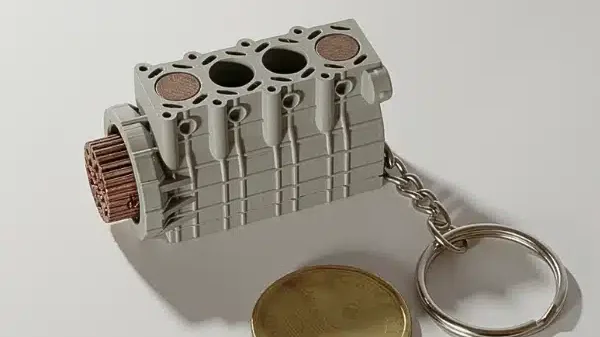
Here is the 4-cylinder engine keychain with moving pistons. One of the best car key accessories in 2026. It is small, but it reflects actual engine movement. These pistons move the way they would inside a real engine block. So it is not a random design. It relates to real mechanics.
The best part is that it is not heavy, light enough to fit in your pocket, and fun to fidget with while planning your next trip.
For someone who works on cars, owns one, or simply appreciates engine details, it becomes more than just a key accessory. It can hang on car keys, a tool bag, or even everyday carry items. Simple, but connected to the vehicle’s power source.
Conclusion
The transponder or chip in every modern car key is small, but it controls something very important. Your car no longer just starts when you turn the key. It starts because the system recognizes and approves that key electronically.
It is part of the immobilizer system, and its job is to verify first, then allow movement. Without that verification, the engine stays locked.
This is why when a car refuses to start, the issue is not always mechanical. Sometimes, electronic authentication fails in the background.
Understanding how the transponder works helps you approach the problem differently. Instead of guessing, you know that recognition is the real factor. And once that is clear, troubleshooting a starting problem becomes easier.