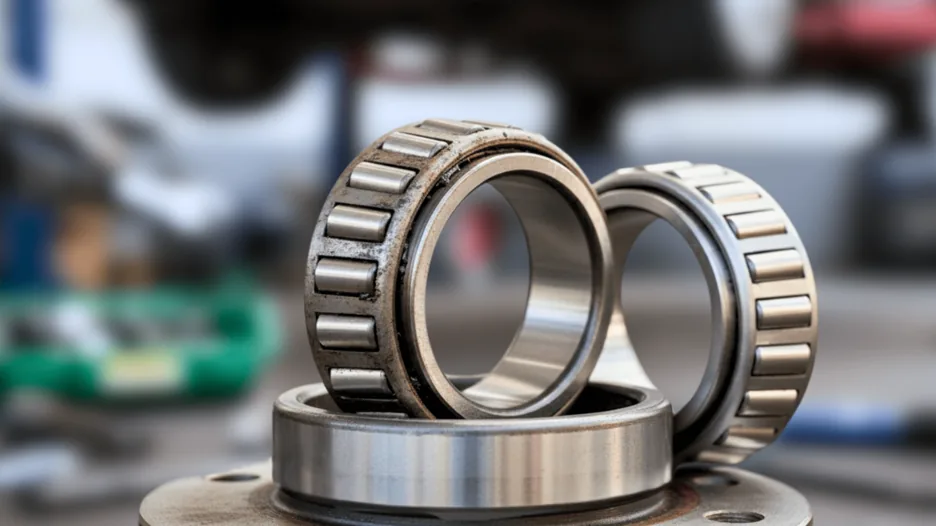
Bearing failures can occur for several reasons. The bearings develop problems such as misalignment, imbalance, play, and friction, all of which can eventually lead to failure. And because bearings are often the most crucial component of a machine, a failure can result in unexpected and costly downtime, damage to other components, and high repair costs.
Each failure makes its own impact on the bearing. In most cases, signs and symptoms of a bad bearing wheel can help you determine the underlying cause of the failure, take corrective action, and prevent it from recurring.
7 signs of wheel bearing failure
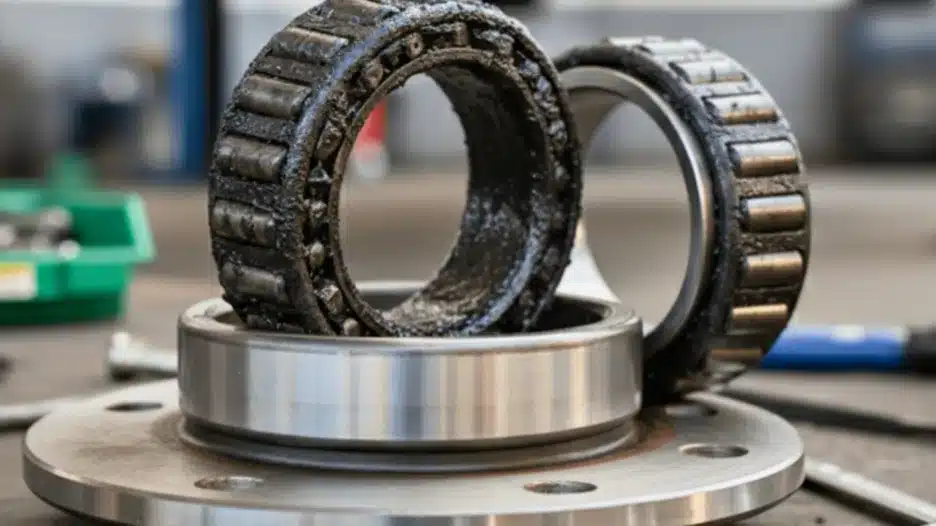
How do I know if a wheel bearing is defective? While some signs may appear subtly and worsen over time, others are more obvious and indicate central dysfunction.
- Noise: a squeaking, buzzing, or whistling sound that varies with speed or when you take a turn is often the first sign of a bearing problem.
- A wheel that seems to oscillate: someone who passes near you may notice that your wheel moves from side to side while you are driving.
- Unusual tyre wear: the tread of one tire may be more worn than that of others, or the wear of the inner part of the tread may be excessive.
- Loose steering: excessive steering wheel movement may be the first sign before the car begins to react.
- ABS light on/ABS activation: An ABS warning light on a wheel hub may not trigger correctly when the bearing moves.
- Vibrations in the steering wheel: at high speed, you may feel vibrations, as if the tires are unbalanced. However, these vibrations can appear and disappear irregularly.
- Braking problems: the caliper may have to tighten more than normal before the braking pressure is applied while the wheel is moving.
You may notice only one of these symptoms, but as the problem evolves, it is likely that several signs will appear.
What is the life of wheel bearings?
Wheel bearings do not have an infinite lifespan. As a general rule, they can travel between 120,000 and 241,000 km. Still, this distance can vary considerably depending on factors such as driving habits, the condition of the roads used, and the quality of the bearings themselves.
Roller bearings also have a much shorter service life than maintenance-free humps.
Ignoring the symptoms caused by a bad bearing can have serious consequences. In addition, if you let the problem worsen, you risk causing premature wear of other parts, such as tires, steering rods, and even the axle rocket, among others.
When you first suspect that a wheel bearing is bad, check for worn or damaged parts, and then plan to have it repaired quickly. Limit your driving until it is repaired or, if it is already very worn, do not drive until the repair has taken place.
One of the best ways to quickly detect wheel bearing problems and avoid worrying signs and damage is to regularly service the vehicle. Perform regular checks, ideally at each engine oil change, to closely monitor the condition of your car.
For roller bearings, it is advisable to re-grease them according to your maintenance book, approximately every 24 months or 20,000 km.
What are the causes of wheel bearing failure?
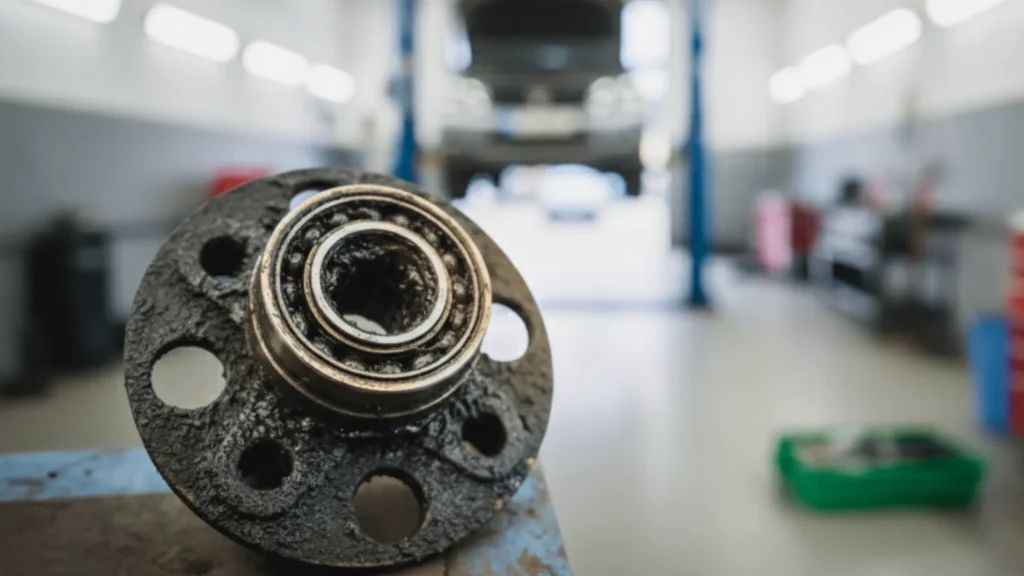
Several factors can be the cause of a defective wheel bearing, including:
- Driving with loads that are too heavy: Exceeding your vehicle’s load capacity can cause excessive stress on the wheel bearings.
- Imbalanced tires: Unbalanced tires, which cause irregular rotation, can put additional stress on the wheel bearings.
- Poor-quality parts: There can be significant differences in quality between low– and high-end parts, and lower-quality parts can break down much earlier.
- Poor lubrication: If the bearings are not properly greased, they can overheat or deteriorate and corrode due to oxidation.
- Bad installation: A poorly performed assembly, resulting in too much force exerted on the bearing, can lead to damage and premature degradation.
- Collision with a sidewalk: A more or less violent impact with a sidewalk can cause the wheel hub to separate or damage the bearing.
- Tight nut: Too much tightening of a nut can crush the ring or bearings, causing the part to wear out quickly.
- Damaged suspension: A broken, worn, or loose shock absorber, spring, or other suspension part can apply pressure to the wheel bearings and cause them to fail.
- Natural wear: After many years of use, wear can manifest itself and requires the replacement of the bearing.
Diagnosis of Wheel Bearing Noise
This part is very important for your car maintenance. Understanding how to diagnose the most common symptom of a bad bearing is a plus.
Initially, the noise will be too weak to be heard. You won’t notice it, but in a few weeks, the noise will get louder. Soon, you will hear a constant noise throughout the drive.
Let’s be clear about this: the wheel rolling noise in your car is one of the most difficult to diagnose. Because you have to drive the car to hear the noise. When the car stops, the noise stops.
However, there are some ways to diagnose wheel bearing noise in your car.
1. Listen while driving
When you are driving, listen carefully. Do you hear a rotating, rhythmic sound that increases with speed? Does the noise become louder and then disappear at certain speeds? If this is the case, you probably have a noise coming from a wheel bearing.
2. Test on a Car Lift
With another person in the vehicle, place your car on a lift and ask them to operate it at a decent speed. Listen to the noise coming from all the wheels. You can indicate which wheel bearing makes noise.
Don’t try this without the right equipment or experience.
3. Swing Test
This is a professional method where you have to drive your car at 50 km/h and swing your car to the right, then to the left, and so on. Do it slowly. If the rhythmic sound moves from left to right, your car has a wheel bearing problem.
To locate the exact wheel that has the problem, listen carefully when you swing the car to the left. If the noise decreases, the problem is on the right side. If the noise decreases when you swing to the right, one of the wheel bearings on the left side has deteriorated.
Once you have spotted that one or more wheel bearings make a noise, the only solution is to replace those that are damaged, and your driving will become silent again.
Extra For Mechanics and Car Enthusiasts
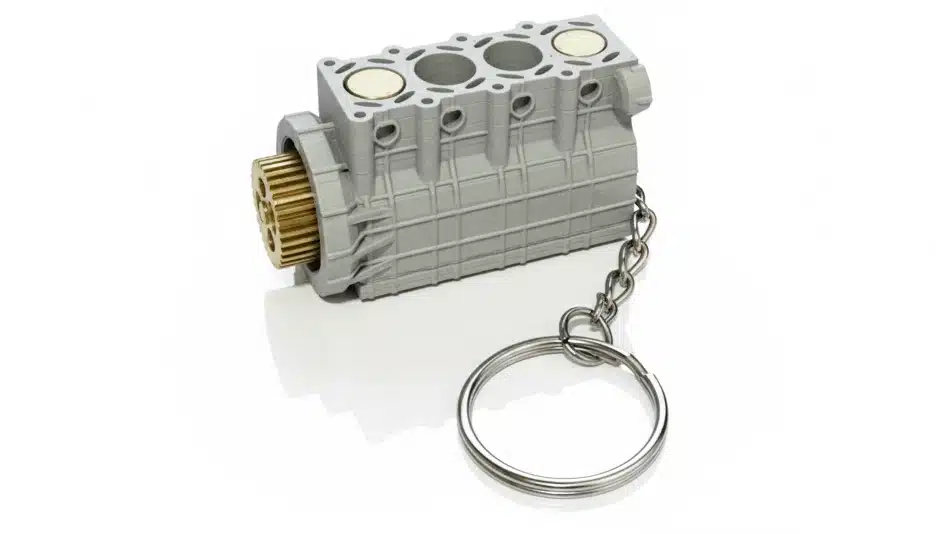
This is the Moving 4-cylinder engine keychain. Perfect for every car lover who is looking for something portable and affordable to reflect their love for cars, this unique automotive keychain is the ideal choice for you.
The moving 4-cylinder engine keychain is also a good gift you can present to your customers as a mechanic or to your friend who has a passion for cars.
Conclusion
The wheel bearings of your car enable smooth, low-friction wheel rotation. These bearings, which are housed inside the hub assembly, allow the wheels to spin freely while supporting the entire weight of your car. When one starts to malfunction, it might cause odd noises, handle improperly, and even have safety problems if left unchecked for too long.
A seized bearing poses a major risk of leaving you stranded or damaging nearby components. You’ll stay safe on the road and prevent more expensive repairs by being able to detect the early warning signs of a damaged wheel bearing.